Posts

Showing posts with the label science

On inflammation, machine learning and lung recovery after COVID-19
Image
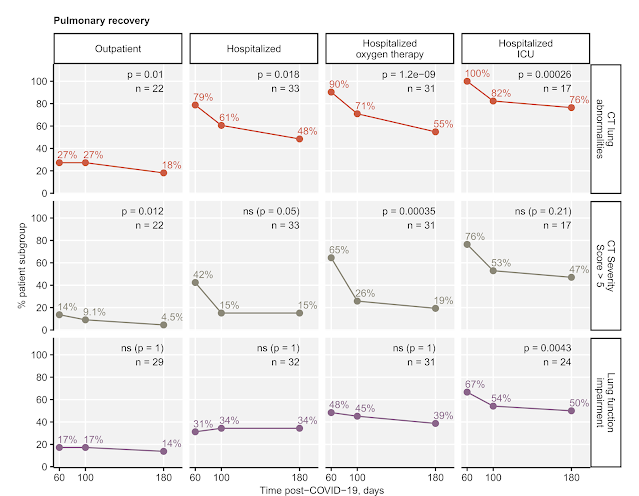
Having your work published is always a great honor and satisfaction, even though your results are not so optimistic. If, by accident, you follow my blog for a while, you may have noticed a post concerning the CovILD project - an observation cohort study, I've been curating as a data scientist. Quite recently, we've managed to publish the follow-up quite prominently in eLife ( Sonnweber et al. ) and develop a toolbox which may help us to assess the risk of complicated recovery from COVID-19, at least when it comes to lung injury and functional deficits. Lung injury following COVID-19 tends to be chronic and symptom-independent As a reminder, at the onset of the SARS-CoV-2 pandemic in Tyrol, a cohort of 145 patients was recruited, including those suffering from mild COVID-19 managed by home isolation and individuals requiring hospitalization, including mechanical oxygen supply and intensive care. The intention of the study was to establish a long-term observation collective to mo...

Pandemic, containment management or COVID-19: what is more dangerous for mental health?

Image
It's again a while since the last post and almost two years of pandemic. Sadly said, a misery which would have been already over, at least in the first world, provided a better vaccination readiness of the US and European societies and more courageous political decisions. Frankly speaking, none of us is the same kind of a woman or men as before the SARS-CoV-2 crisis. Besides the real threats to our somatic health, there's another facet of human well being less prominently addressed by media news and scientific publications: mental health. Fear, paranoid feeling of being locked up, overwhelming concerns about own and family health, household finances, kids without school, lost jobs... This all has been burdening us and now seems to be somehow over but not completely. Could we measure this impact on mental integrity? Could we find out the causes? Is there a way to identify people at risk of mental health deterioration early on and help them? The team of 'Health after COVID-19...

'Mild-course', home-isolated: still a missing puzzle to understand the COVID-19 pandemic

Image
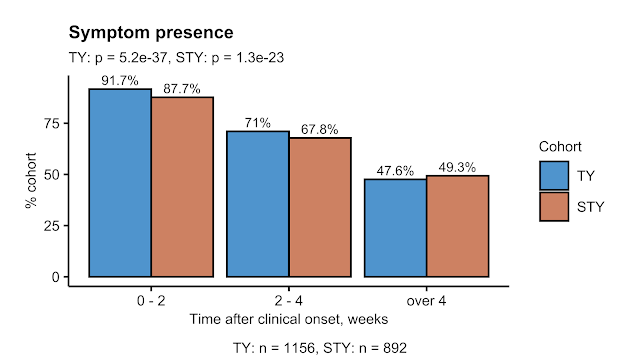
Since the last post (a while ago), many things happened: to the pandemic, which we can now effectively fight against, to the awakening world economy, the even warmer climate... But also to the blog author, who now pursuits a free-lance data scientist career ( https://www.daas.tirol/ ) - any time happy to crunch your exciting data! In the mean time, I spent days if not weeks with an extremely interesting project named simply ' Health after COVID-19 in Tyrol ', whose results, while still not 'properly' published, can be accessed as a preprint . Well, probably there's probably no single person who hasn't heard the term 'long COVID', either from media, friends or relatives - a phenomenon of symptom persistence long after the acute SARS-CoV2 infection ranging from an isolated smell disorder to debilitating shortness of breath making everyday life a hard struggle. Even though the condition follows the 'ebb and flow' pattern of broad public interest, th...

COVID-19 recovery may be a long, tough challenge

Image
After reading my previous two critical posts on mass testing , you may have got an impression that I tend to see COVID-19 and its causal pathogen as just another contagious disease and just another common bug which plague us on these fall and winter days. But it's not! Similar to influenza, COVID-19 falls into the set of the most dangerous infectious conditions present in the developed world. Recently, a nice and very important paper by my colleagues Thomas Sonnweber and Sabina Sahanic was issued in the prominent European Respiratory Journal (DOI: 10.1183/13993003.03481-2020 , open full text) with may tiny contribution as a data analyst. Interestingly, it seems to be one of a handful stories which investigate the recovery of COVID-19 individuals, both those with mild 'cold-like' symptoms and hospitalized patients, in a systematic way with a spectrum of quality-of-life parameters and hard-figure lung/heart function and imaging parameters. Let's have a brief look at the m...